
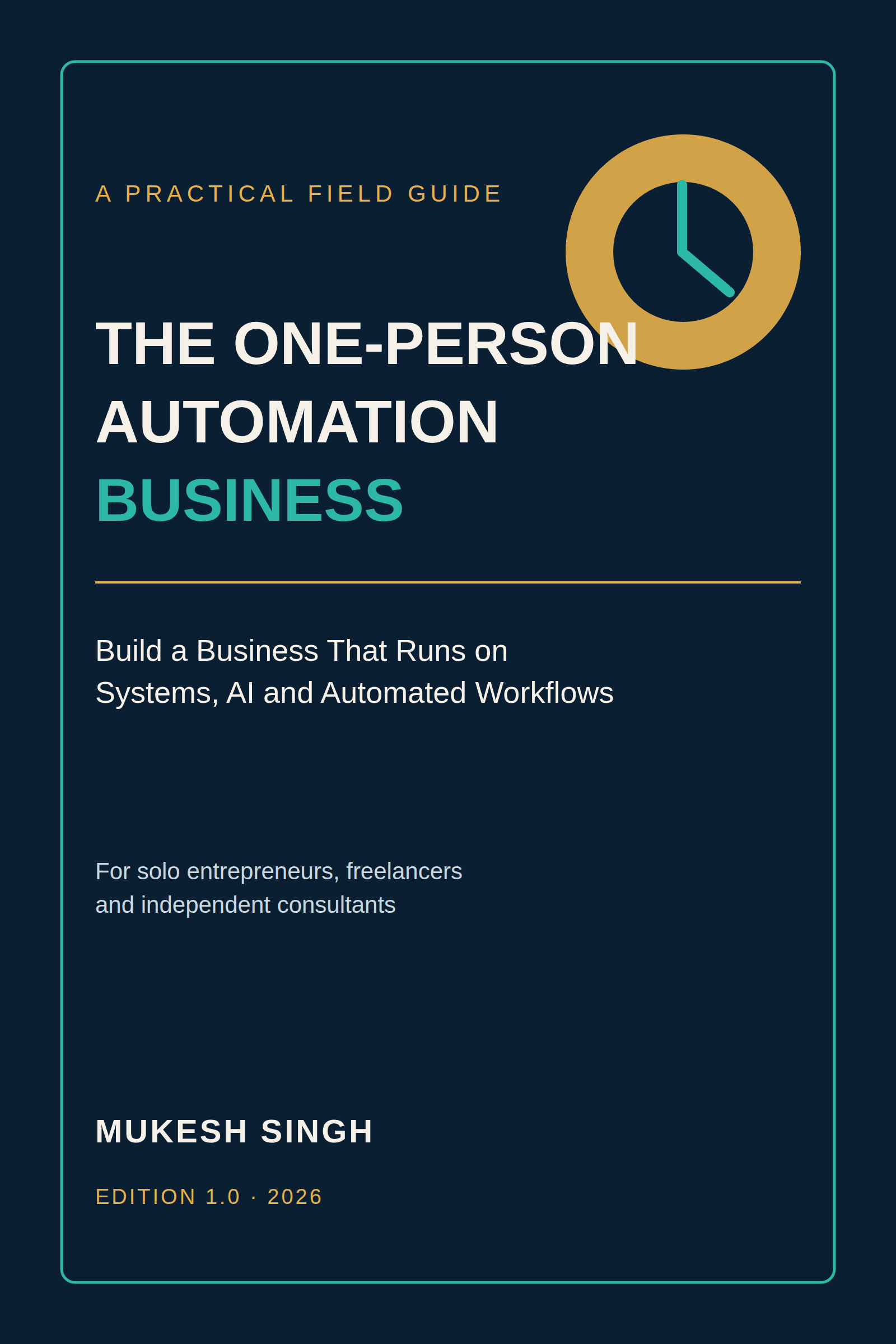
The One-Person Automation Business
Build a Business That Runs on Systems, AI and Automated Workflows – Edition 1.0, by Mukesh Singh
A practical operations playbook for solo entrepreneurs, freelancers, solo consultants, small agencies and digital-product creators. It gives you one repeatable way to capture leads, close sales, onboard customers, deliver the work and handle follow-up – without running every task from memory.
It is not a list of AI tools and it is not a passive-income promise. It is a method for deciding what to automate, what must stay human, and how to prove a workflow works before it touches a customer.
On this page: what is included – what you will be able to do – the method – contents – the fifteen blueprints – the file list – editions – questions – limits
Ebook Sample : one-person-automation-business-sample
What is included in the Complete bundle
- A 41-page A4 ebook in PDF. Fourteen chapters, real text rather than page images, so it is searchable, selectable and accessible to screen readers.
- Fifteen standalone workflow blueprints in Markdown. Each one carries the same fourteen sections: business outcome, best-fit customer, trigger, required data, systems involved, workflow steps, business rules, AI usage, human approval, failure handling, security and privacy, test cases, success metrics and manual fallback.
- Nine editable templates in Markdown and CSV: business automation canvas, process inventory, automation opportunity scorecard, workflow specification, test-case checklist, pre-launch checklist, weekly business review, thirty-day implementation tracker and dashboard specification.
- A 25-prompt library for mapping a manual process, finding automation opportunities, defining a source of truth, generating test cases and reviewing failure modes.
- An ROI workbook in XLSX. The figures in it are illustrative placeholders; you replace them with your own baseline, costs and maintenance time.
- A companion index that names the exact file behind each chapter, so you never have to guess which template a section refers to.
- A reference register recording the sources behind the book’s market context and the verification status of each entry.
- The complete book as an accessible Markdown text file, for readers who prefer plain text or want to search across everything at once.
- A quick-start guide for the first session: what to read, what to fill in and what to ignore until later.
- The review records for this edition – content review, technical review, release checklist and the automated verification report – so you can see what was checked and what was not.
- A free 13-page sample edition: chapters 1-3 and the first blueprint, verbatim from the full book.
Every file is a PDF, Markdown file, CSV or spreadsheet. Nothing requires an account, an app, a subscription or a connection to a service you do not already use.
What you will be able to do
- Map the customer journey from first discovery through referral, and see where the work actually happens.
- Choose the first workflow worth improving instead of automating the loudest annoyance.
- Separate deterministic rules from AI-assisted drafting, and name the decisions that must stay human.
- Define a source of truth, record states, approval points and fallbacks for each workflow.
- Test a workflow for duplicate events, timeouts, bad data and partial success before a customer meets it.
- Run a focused thirty-day implementation sprint with a weekly review that measures what changed.
The method: SOLO
One operating sequence, four stages. Each stage has a question it answers and a decision it has to survive before the next stage is worth starting. SOLO is an organizing device for this book, not a validated research model – and the book says so.
| Stage | The question it answers | What you should be able to show | Chapters |
|---|---|---|---|
| Scope | Whose problem, which offer, and is the problem real? | A named customer, a costly problem, an offer statement and validation evidence | 2, 3 |
| Operate | How does the work happen today, and where does the truth live? | A process inventory, one source of truth per record and defined states | 3, 4 |
| Leverage | Which steps should software take, and which must stay human? | Workflow specifications, AI boundaries and a chosen stack | 5, 6, 7 |
| Optimize | What did the change actually do, and what happens next? | Price and unit economics, a small dashboard, a review loop and a sprint | 8, 9, 10, 11, 12 |
Contents: fourteen chapters
| Chapter | Title |
|---|---|
| 1 | The One-Person Business Advantage |
| 2 | Start With the Business, Not the Automation |
| 3 | Map Your Business Operating System |
| 4 | The Automation Architecture |
| 5 | The 15 Essential Workflow Blueprints |
| 6 | AI: Where It Helps and Where It Must Not Decide |
| 7 | Choose Your Automation Stack |
| 8 | Build a Productized Service or Digital Product Business |
| 9 | Revenue Models and Unit Economics |
| 10 | Reliability, Security and Human Oversight |
| 11 | Measure Results and Improve the System |
| 12 | Your 30-Day Implementation Sprint |
| 13 | Templates, Checklists and AI Prompts |
| 14 | Further Learning and References |
The fifteen workflow blueprints
Each blueprint stands alone. You can open the one you need without reading the rest of the book, and each follows the same fourteen-section structure so they are comparable and reviewable.
- 01. Lead Capture and Acknowledgement
- 02. Lead Qualification and Routing
- 03. Appointment Scheduling
- 04. Proposal Preparation
- 05. Invoice and Payment Follow-Up
- 06. Client Onboarding
- 07. Project Delivery Coordination
- 08. Digital Product Fulfillment
- 09. Customer Support Triage
- 10. Feedback and Testimonial Request
- 11. Renewal and Retention
- 12. Content Repurposing
- 13. Weekly Business Review
- 14. Expense and Document Organization
- 15. Exception and Failure Alerting
The file list
This is everything you can download in the Complete bundle. The folder names match the folder names inside the download, so a file named on this page is a file you can find without searching.
| Folder | Files | Format |
|---|---|---|
| ebook/ | The book (41 pages, 14 chapters) and the accessible text version | PDF, Markdown |
| blueprints/ | Fifteen workflow blueprints, numbered 01 to 15 | Markdown |
| templates/ | Nine editable templates, six documents and three CSV worksheets | Markdown, CSV |
| prompts/ | 25-prompt library | Markdown |
| calculators/ | Automation ROI workbook | XLSX |
| manuscript/ | Reference register | Markdown |
| resources/ | Companion index: which file belongs to which chapter | Markdown |
| sales/ | Quick-start guide for the first session | Markdown |
| qa/ | Content review, technical review, release checklist and automated verification report | Markdown |
| sample/ | Free sample edition (13 pages: chapters 1-3 and Blueprint 1) | |
| root | START-HERE.md and a checksum list you can use to confirm the download arrived intact | Markdown, text |
The nine templates, by file name
| File | What you fill in |
|---|---|
| business-automation-canvas.md | One page, completed before you choose a tool: customer, problem, offer and scope |
| process-inventory.csv | Every recurring process, its trigger, manual steps, frequency, minutes per occurrence, exception rate and risk if it fails |
| automation-opportunity-scorecard.csv | Each candidate workflow scored 1 to 5 so the choice is a decision rather than a preference |
| workflow-specification.md | The specification for the one workflow you chose: states, rules, approvals and fallbacks |
| test-case-checklist.md | The test cases that must pass, including duplicates, timeouts, bad data and partial success |
| prelaunch-checklist.md | The readiness review on business, technical and failure handling before anyone meets the workflow |
| weekly-business-review.md | The weekly review: what happened, what changed, what you decided next |
| 30-day-implementation-tracker.md | The sprint log: business, start date, workflow in scope and owner |
| dashboard-spec.csv | Each metric with definition, source system, calculation, frequency, baseline, target and alert threshold |
Editions: Core and Complete
The Complete bundle is the edition described on this page. A smaller Core edition is also offered for readers who only want the book and the blueprints. The file list below is the definition of each edition – nothing is promised that is not on it.
| Included | Core edition | Complete bundle |
|---|---|---|
| Ebook PDF, 41 pages, 14 chapters | Yes | Yes |
| Chapter 12, the thirty-day implementation sprint (inside the PDF) | Yes | Yes |
| Fifteen workflow blueprints | Yes | Yes |
| Business automation canvas, workflow specification and pre-launch checklist | Yes | Yes |
| Reference register | Yes | Yes |
| Nine editable templates in Markdown and CSV | Three of the nine | All nine |
| 25-prompt library | Not included | Yes |
| ROI workbook (XLSX) | Not included | Yes |
| Accessible Markdown text version of the book | Not included | Yes |
| Quick-start guide | Not included | Yes |
| Companion index | Not included | Yes |
| Review records for this edition | Not included | Yes |
| Free 13-page sample edition | Yes | Yes |
Who it is for
- Freelancers and solo consultants whose week disappears into quoting, scheduling, chasing and onboarding.
- Owners of one to five-person service businesses who need the operation documented before hiring or delegating.
- Digital-product creators who want a repeatable fulfilment and support path rather than a manual one.
- Anyone who has workflow tools already and needs the specification, test cases and review loop that keep them from breaking quietly.
Who it is not for
- Buyers looking for guaranteed income, passive-income systems or a business that runs without decisions.
- Readers who want a ranked list of AI tools to subscribe to.
- Developers looking for a code-first tutorial on a specific platform’s API.
How to use it
The order below is the order the book uses. Each step names the file it produces, so you can stop after any step and still hold something usable.
| Step | What you do | File you fill in |
|---|---|---|
| 1 | Read chapters 1-4 and describe one customer, one problem and one offer on a single page. | business-automation-canvas.md |
| 2 | List the recurring tasks you currently do yourself, with frequency and what a failure costs. | process-inventory.csv |
| 3 | Score the candidates and pick exactly one workflow to improve. | automation-opportunity-scorecard.csv |
| 4 | Open that workflow’s blueprint and write the specification: trigger, states, rules, approvals, fallback. | workflow-specification.md |
| 5 | Turn the blueprint’s test cases into the checks that must pass before launch. | test-case-checklist.md |
| 6 | Verify readiness: duplicates, timeouts, bad data, partial success, access, rollback. | prelaunch-checklist.md |
| 7 | Run the sprint, review weekly against one metric and keep the dashboard small. | 30-day-implementation-tracker.md |
Questions
Do I need to be a developer?
No. The book explains the operating concepts first and treats tools as replaceable implementation choices. Some workflows may eventually justify code, but the first version can be manual, native or no-code.
Is this a passive-income guide?
No. It is an operations playbook. Automation can reduce repetitive coordination; it does not create demand, repair an offer or remove the need for judgment and support.
Which tools are included?
None are bundled or required. The product is vendor-neutral: tools appear as categories and starting points, not as endorsements, and the book asks you to verify current pricing, regional availability, terms and data handling before you deploy anything.
Are the calculations forecasts?
No. Revenue and ROI examples are illustrative calculations. Replace them with your own baseline, costs, maintenance time and evidence.
What is the difference between Core and Complete?
Core contains the PDF ebook, the fifteen blueprints, the canvas, workflow specification, pre-launch checklist and the reference register. Complete adds the full nine-template set, the 25-prompt library, the ROI workbook, the accessible text version, the quick-start guide, the companion index and the review records. The table above is the authoritative list.
Is the free sample the whole book?
No. The sample reproduces chapters 1-3 and Blueprint 1 verbatim, 13 pages of the 41-page book. Chapters 4-14 and the other fourteen blueprints are in the full edition.
What this product does not promise
- It does not promise passive income, guaranteed revenue or a business that runs without your decisions.
- It does not guarantee that any specific tool will suit your workflow, stay available, or keep its current price and features.
- Its templates and checklists are planning aids, not legal, tax, accounting, security or compliance advice.
- Its figures are illustrative calculations, not forecasts of your results.
- It contains no customer testimonials or case studies, because this is the first edition and none have been collected.
Edition and rights
The One-Person Automation Business, Edition 1.0, November 2026. Copyright 2026 Mukesh Singh. All rights reserved.
Use the book and its companion files inside your own business. Short quotations with attribution are welcome. Reproducing, reselling or redistributing the book, its cover or its companion files, in whole or in substantial part, requires written permission from the author.